Cloud PBX: Benefits, Costs, and How SMEs Should Compare Providers
Andreas Braunizar
Business Development
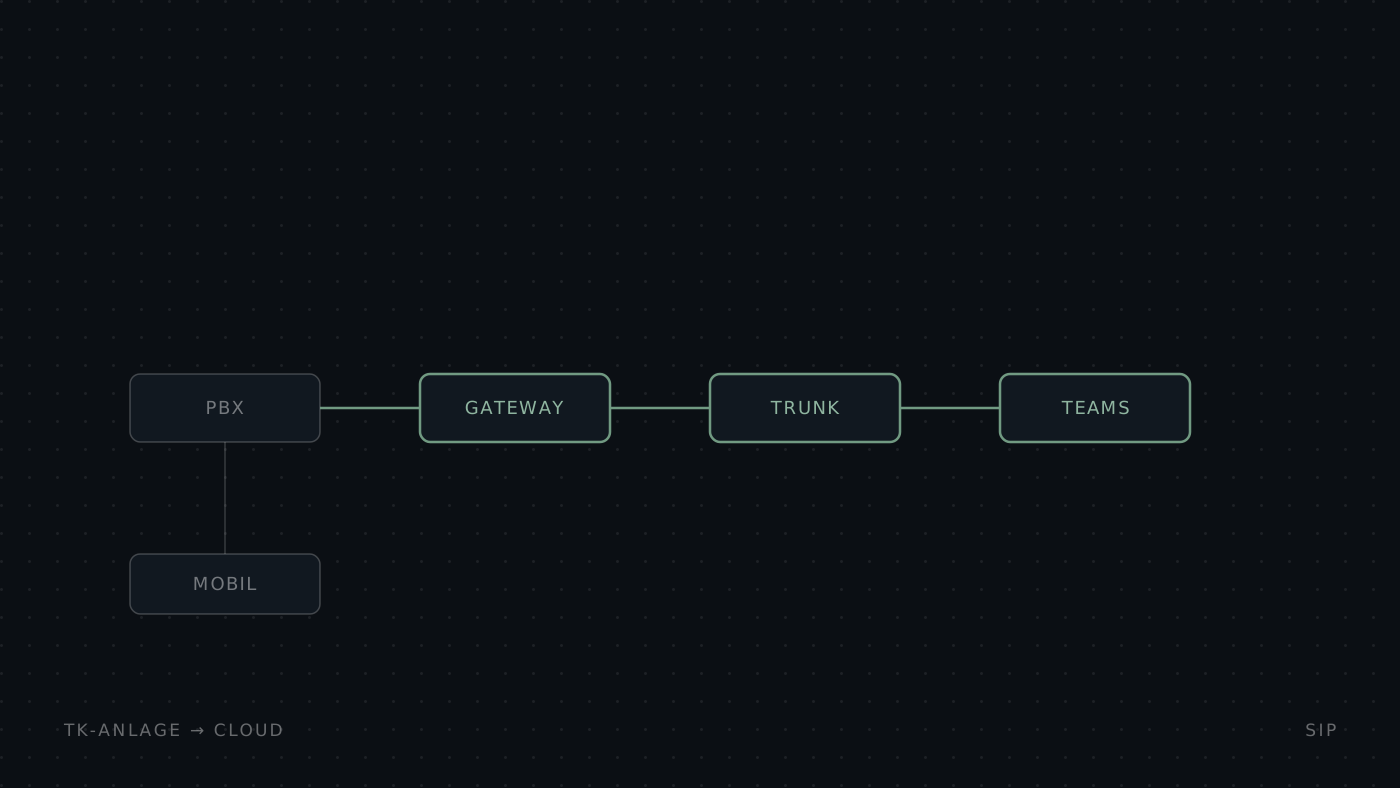
Summary: A cloud PBX, also called a virtual PBX, moves the entire switching technology from your server room to the provider's data centre. Small businesses pay €8-22 per extension per month instead of €3,000-15,000 upfront for a classic PBX, setup takes 3-5 business days instead of several weeks, and contracts typically run 1-12 months instead of 36. The decisive factors when choosing a provider are number portability, EU hosting, and whether the operator is independent of a single carrier.
What Exactly Is a Cloud PBX?
A cloud PBX is a virtual telephone system: the entire switching technology that used to sit as a grey box in the server room now runs in the provider's data centre and is used over the internet. Extensions, queues, announcements, and call forwarding are configured through a web portal, not by a technician on site.
For users, little changes. They still make calls through a desk phone, a smartphone app, or a softphone on their computer. For IT, a lot changes: no maintenance contracts for hardware, no firmware updates on your own device, no sourcing spare parts when a circuit board fails.
Cloud PBX, Cloud Telephony, Virtual PBX: Is There a Difference?
In practice these terms are used largely interchangeably. Cloud telephony describes the principle (telephony delivered from the cloud), while cloud PBX and virtual PBX emphasise the system that replaces the classic on-premise unit. It is worth distinguishing this from plain VoIP: VoIP is the transmission technology, while a cloud PBX is the complete system of extensions, call routing, auto attendant, and admin interface built on top of it.
What Does a Cloud PBX Cost Small Businesses?
The cost structure differs fundamentally from a classic system. Instead of a large upfront investment, you pay a monthly fee per extension that usually includes maintenance, updates, and a flat rate for calls to German and Austrian landlines.
| System type | Upfront cost | Cost per extension/month | Contract commitment | Setup time | |
|---|---|---|---|---|---|
| Classic PBX (on-premise) | €3,000-15,000 hardware | €15-30 (maintenance, licences) | often 36-month maintenance contract | 3-6 weeks | |
| Cloud / virtual PBX | none, IP phones optional at €50-150 each | €8-22 (flat rate incl.) | 1-12 months | 3-5 business days | |
| Cloud PBX with Teams integration | IP phones optional | €15-30 | 1-12 months | 1-2 weeks |
Adding a new extension on a cloud system takes minutes, because no technician needs to fit a port card. That makes cloud PBX systems especially attractive for growing or seasonally fluctuating teams.
When Does a Cloud PBX Pay Off for Small Businesses?
For a company with 3-20 employees, the switch almost always pays off once the existing system is due for renewal anyway, a maintenance contract expiring, ISDN having been switched off, or a move on the calendar. Without an upfront investment, the switch often pays for itself within the first few months, purely through lower running costs and dropped maintenance fees. For very small teams under five people, there is an additional benefit: no minimum order quantity for hardware ports.
Which Criteria Should You Check Before Choosing?
Not every cloud PBX fits every business. These points belong on the table before a decision:
- Number portability: Can you keep your existing numbers, and how long does it take?
- Hosting location: Does the system run in an EU data centre, with a GDPR-compliant data processing agreement?
- Carrier independence: Is the operator locked to a single carrier, or can they switch the SIP trunk when needed without rebuilding your system?
- Integration: Can the system connect to Microsoft Teams, a CRM, or your ticketing system? The three connectivity paths for Teams are explained in Setting up Microsoft Teams telephony.
- Scaling: Can you add and remove extensions yourself without a minimum term per extension?
- Support reachability: Is there a fixed point of contact, or do you land in a new ticket queue every time you call?
Case in Point: A Tax Advisory Firm with 14 Employees
A tax advisory firm in Lower Austria was running an 18-year-old PBX for which spare parts were becoming hard to find. The switch to a cloud PBX connected to Microsoft Teams was completed within two weeks, including porting all nine direct-dial numbers. Monthly fixed costs dropped from around €340 to €210, and the team can now also be reached at their office extension from home.
Why Anexum Operates the System Instead of Just Selling It
Many providers on the market are SaaS platforms locked to a single SIP trunk provider. Anexum works as an independent operator: we select the right carrier for your location, host the system in Germany, and stay a fixed point of contact for technology, numbers, and contract. If market conditions shift or a carrier raises prices, we swap the trunk in the background, without your users noticing.
Conclusion
A cloud PBX lowers running costs, cuts setup time to a few days, and frees you from ageing hardware in a server room. What matters more than the provider's name is who operates the system, how independent they are from a single carrier, and how fast they respond when something breaks. Read more about our approach on Enterprise Voice at Anexum.
Frequently Asked Questions
What is the difference between a cloud PBX and VoIP?
VoIP is the transmission technology that sends voice as data packets over the internet. A cloud PBX is the complete system of extensions, queues, announcements, and admin interface built on top of VoIP.
How much does a cloud PBX cost per user?
Depending on the feature set, between €8 and €30 per extension per month, usually including a flat rate to German and Austrian landlines. IP phones are an optional extra at €50-150 each.
Is a cloud PBX GDPR compliant?
That depends on the provider and hosting location. Look for an EU data centre and a data processing agreement. Anexum operates its systems on infrastructure in Germany.
Can I keep my existing phone numbers?
Yes, number portability is legally required in Austria and Germany. It takes 5-10 business days depending on the carrier and runs without any interruption to reachability.
How long does it take to set up a cloud PBX?
For a small business with up to 20 extensions, typically 3-5 business days, or one to two weeks with Teams integration. Number portability runs in parallel in the background.