The A1 Outage of 11 August: Calls Down, Data Up
Florian Hödl
Network Monitoring and Automation
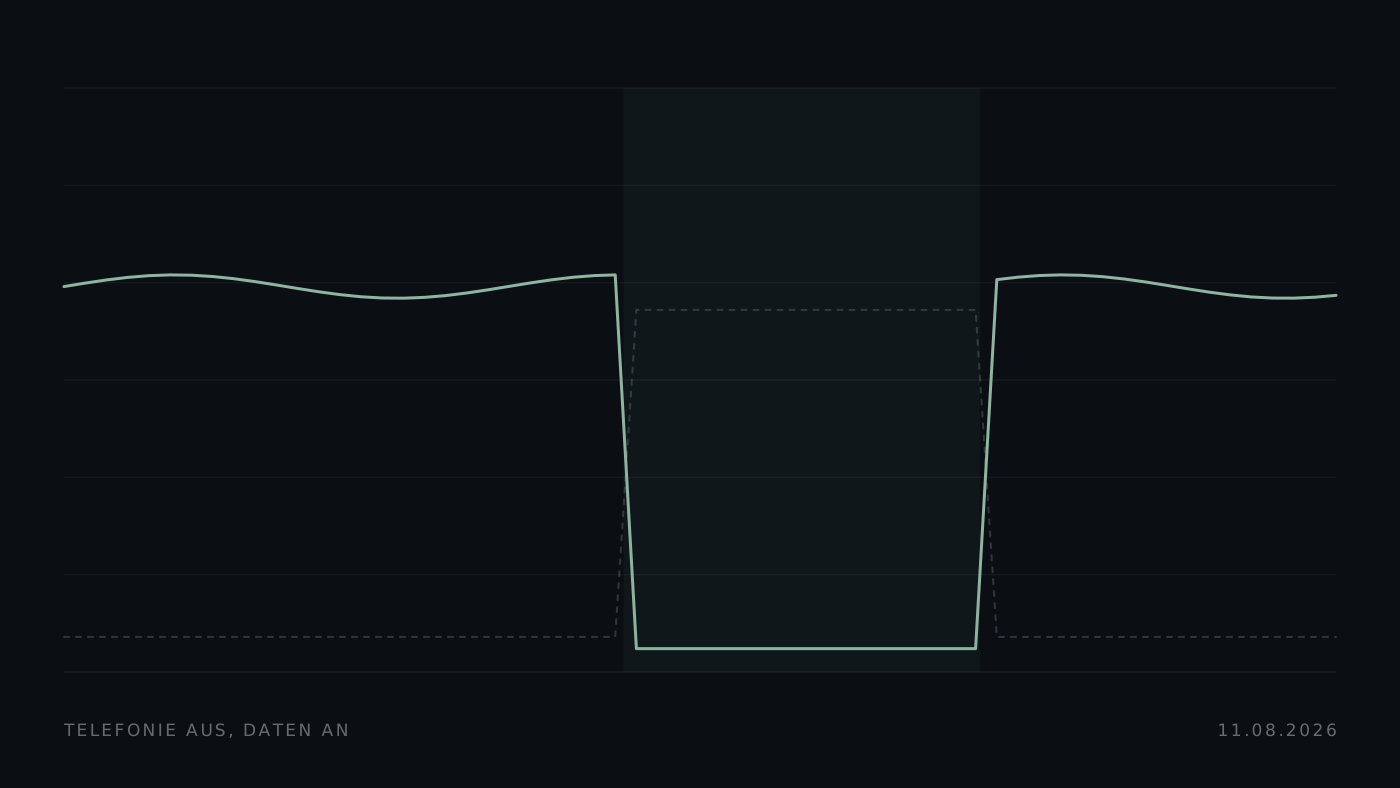
In short: A network outage is rarely one condition. It is usually several at once. On 11 August, voice telephony, TV, the operator's website and dependent services went down, while mobile data and site connectivity largely kept working. That is not a technicality. It decides whether a business could work that afternoon or not. For anyone running distributed sites, three questions follow, and the answers are usually uncomfortable.
What happened that afternoon
Reports about the A1 network started piling up at around 15:30. On the Austrian outage reporting platform Allestörungen they peaked at roughly 2,000 around 16:30. The breakdown is the first interesting detail: about 38 per cent concerned TV, 34 per cent voice calls and 16 per cent mobile internet. A1's own website, its fault hotline and services depending on that infrastructure were affected as well, including a parking payment app. Discount brands operating on the A1 network reported outages too.
At around 17:00, A1 stated that no restrictions remained. Individual users continued reporting problems into the evening. Later that evening the operator became more specific: the fault had lasted from roughly 15:15 to 17:00, it had caused "outages and malfunctions in various A1 services", and systems would continue to be monitored closely. On the cause, the wording was that it had been identified. It was not named, and as of 12 August that is still where the public record stands. The operator's newsroom, which regularly carries awards and network expansion projects, says nothing about that afternoon.
Why calls failed while the internet kept working
One sentence appears strikingly often in the public discussions from that afternoon: voice is dead, mobile data works. It sounds contradictory. It is the rule rather than the exception.
In mobile networks, voice has for years been a service running over dedicated components in the core network, the IMS. Data traffic takes a different path. When the voice layer fails, the data connection survives: the phone shows full bars, messages go out over internet services, only the call never connects. Fixed-line telephony over fibre often depends on the same layer, which is why it tends to fail together with mobile voice.
That also answers a question asked repeatedly that afternoon: why does the phone not simply switch to another network? Because it sees no reason to. The device checks whether it can register on its home network. It could. There is no mechanism that detects "this operator's voice service is currently broken" and switches operator as a result. A handset only moves to another network when its own is unavailable altogether. The exception is the emergency call, which is set up over any reachable mast, regardless of operator and regardless of whether a SIM is inserted.
What our measurements showed
We monitor the internet connections of business sites across Austria at one-minute intervals, a substantial share of them on the A1 network. During the outage window, exactly one of those sites went down.
That figure needs its caveat, otherwise it claims too much. We measure reachability of the data connection, not voice and not television. In other words, we did not measure the very thing that mainly failed that day. What the measurement does show is still the decisive piece of information for a business: the sites stayed connected. Whoever was working at those sites could keep working. Whoever needed to make a call could not.
One aside that rounds out the picture: the author of this post is privately on a discount tariff on the same network and did experience restrictions that afternoon. Same outage, same hour, different experiences depending on which path through the network you sit on.
The most uncomfortable observation of the day
It is not in the news coverage, it is in the comments under the outage reports. The most common complaint was not the outage itself. It was that the fault hotline could not be reached either.
That is the moment customers stop assessing a technical problem and start assessing a provider. And it is a pattern that repeats in every organisation that routes its escalation path through the same technology that has just failed. If you have to report the failure of your phone system by phone, you do not have an escalation path. You have a hope.
Three questions for the day after
An outage day is the one moment when these questions can be answered without debate, because the answer is still fresh.
First: which of your sites depend on exactly one path? A failure in an operator's central systems gives no warning. Fibre and microwave links degrade measurably before they fail, and there early warning is realistic. For everything else, only a second, physically separate path helps. A second contract with the same operator is not one, because in a real incident it runs through the same central systems.
Second: does your escalation path depend on technology that can fail? If reporting a fault requires a phone number and the phone service is the fault, you need a second channel that is demonstrably independent.
Third: who noticed the outage first, your monitoring or your customer? If the answer is "the customer", that is not a communication problem. It is a gap in your monitoring.
What this post does not say
It does not say that an operator did a bad job. An outage like this can hit any network, and the engineers who fixed it had a long afternoon. It also does not say that we could have predicted it. That is precisely the point: failures in central systems arrive without warning, and no monitoring in the world changes that. What monitoring can do is answer the question that matters on the day: does this affect me, which of my sites, and since when.
That is exactly what we take care of in internet monitoring, and the reasoning behind it is described in network monitoring that thinks. If you want to know how your sites held up that afternoon, let's talk.
Two earlier outages on the same network
Anyone treating that afternoon as a one-off will find two counterexamples in the years before it, and both show a different pattern from 11 August.
On 14 October 2019, fixed-line telephony failed nationwide for around four and a half hours, emergency numbers included. The trigger was a hardware fault in a control element of the fixed-line voice platform. While the faulty component was being replaced, the safeguard was disabled, which overloaded the signalling layer. The real damage was done while fixing the original fault. One detail from that day is still instructive: not a single emergency call vanished. The signalling reached the control rooms, only speech was not carried, so the dispatchers called back.
On 18 February 2021, a DDoS attack took down fixed-line internet across Austria for a good hour. Fixed and mobile voice, along with mobile data, kept running. That is the exact mirror image of 11 August: back then the data path was down and calls worked, this time round it was the other way.
Two outages on the same network, two opposite patterns. That is the practical reason why the blanket question "is the network down" is worth nothing. It has three possible answers, and which one applies decides the working day.
What days like this look like statistically
Network operators in the EU have to report significant incidents to their regulator, and those reports are aggregated by the EU agency ENISA. The most recent report covers 2024: 188 incidents from 26 EU member states and two EFTA countries, a fifth more than the year before. Across all of them, 1.74 billion user hours were lost, down from 3.9 billion in 2023. Across the full reporting period that works out at one reportable incident every two days in Europe.
The breakdown by root cause is where it gets interesting. System failures accounted for 113 of the 188 incidents, or 60 per cent. Human error followed with 19 per cent, natural phenomena with 13, malicious actions with 8. Within the system failures, software bugs and hardware faults are the two most common technical causes, at 19 per cent each. And 2024 was no outlier: since 2012, system failures have topped the table in every single year, averaging 65 per cent of all incidents.
The second figure concerns impact, and it reverses the ranking. The most frequent single technical cause in 2024 was the cable cut, with 41 incidents. Count user hours lost instead of incidents and the faulty software change moves to the front: 515 million hours against 331 million for cable cuts. The digger happens more often. The botched change to a running system costs more.
A third figure fits that afternoon particularly well: 65 of the 188 incidents were traced to failures at third parties. Buying a connection means buying a chain of suppliers that never appears in the contract.
For 11 August that means the phrase "some internal and external systems" describes precisely the category that has led this statistic for thirteen years. The least likely outage is the one you can picture, the severed line. The most likely one is the one you cannot see.
Frequently asked questions
Why does the internet work while calls fail?
Because voice and data run over different components in mobile networks. Voice is handled by the IMS, data traffic takes a different path through the core network. When the voice layer fails, the data connection remains, and the device still shows full signal.
Why does my phone not automatically switch to another network during an outage?
Because it registers successfully on its own network and therefore detects no fault. A handset only moves to another network when its own is unavailable altogether. There is no check on whether individual operator services are working.
Do emergency calls work when my operator has an outage?
Emergency calls are set up over any reachable mast, regardless of operator, which makes them considerably more robust than ordinary calls. Anyone reachable solely through a fixed-line VoIP phone does not have that safeguard.
Does monitoring help against an outage like this?
It does not prevent it. It answers the questions that matter on the day: is my site affected, since when, and is the cause my equipment or the operator's network. Without your own measurements you are left with the operator's statement, which arrives late and applies to the whole country rather than to your site.
So what does help against failures in central systems?
A second, physically separate path. Separation is what matters: a second contract with the same operator runs through the same central systems in case of doubt and fails together with the first.